


5/11/2026 – 21/03/2027
Opening – November 5, 2026, at 7:30 PM
Performance by Leo Robinson at 8:00 PM
The unique collection of the Museum of Contemporary Art in Skopje offers great potential for discovery and rediscovery. We continue to be surprised by the possibilities in the collection brought forth by researchers. Consequently, a guiding principle of the Museum is an openness to reshaping narratives, alongside the encouragement and support of research into new relations and interpretations.
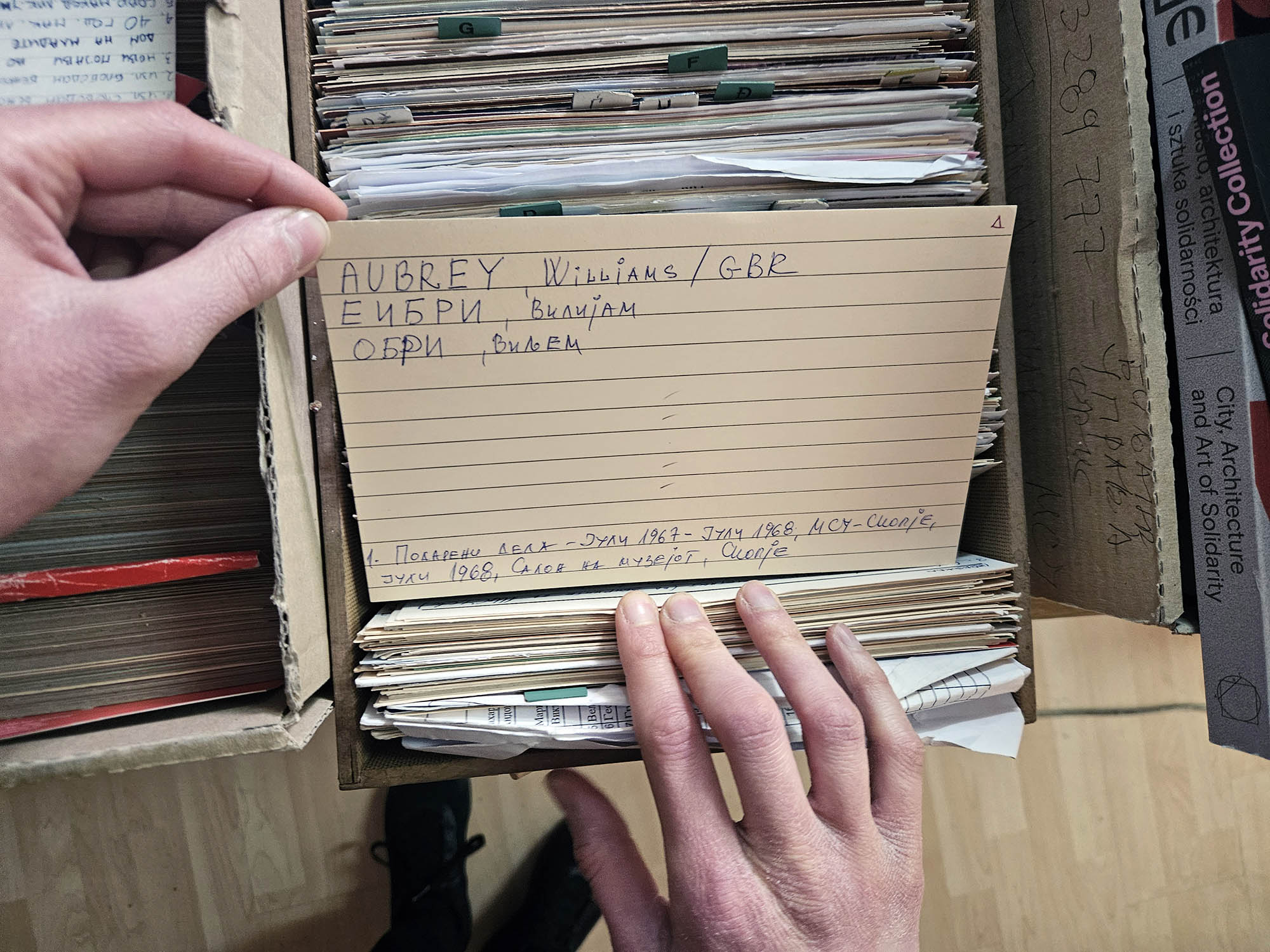
Aubrey Williams’ (1926–1990) abstract paintings evoke the elemental forces of earth, fire, and cataclysm. As the artist’s groundbreaking practice has received greater recognition in Britain—where, with Guyana, Jamaica, and Florida, he lived and worked—two of his early works have risked being lost in the collection of the Museum of Contemporary Art in Skopje (MoCA-Skopje), by a simple mistake in the institution’s cataloguing system.
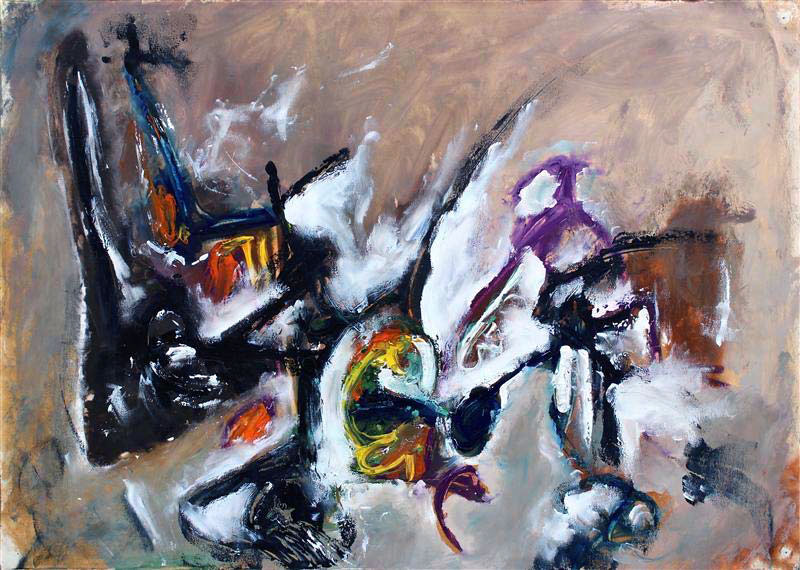
Williams Aubrey, Hunting Тrophy, 1959, tempera on paper, 40 x 55 cm. Collection of paintings, MoCA Skopje
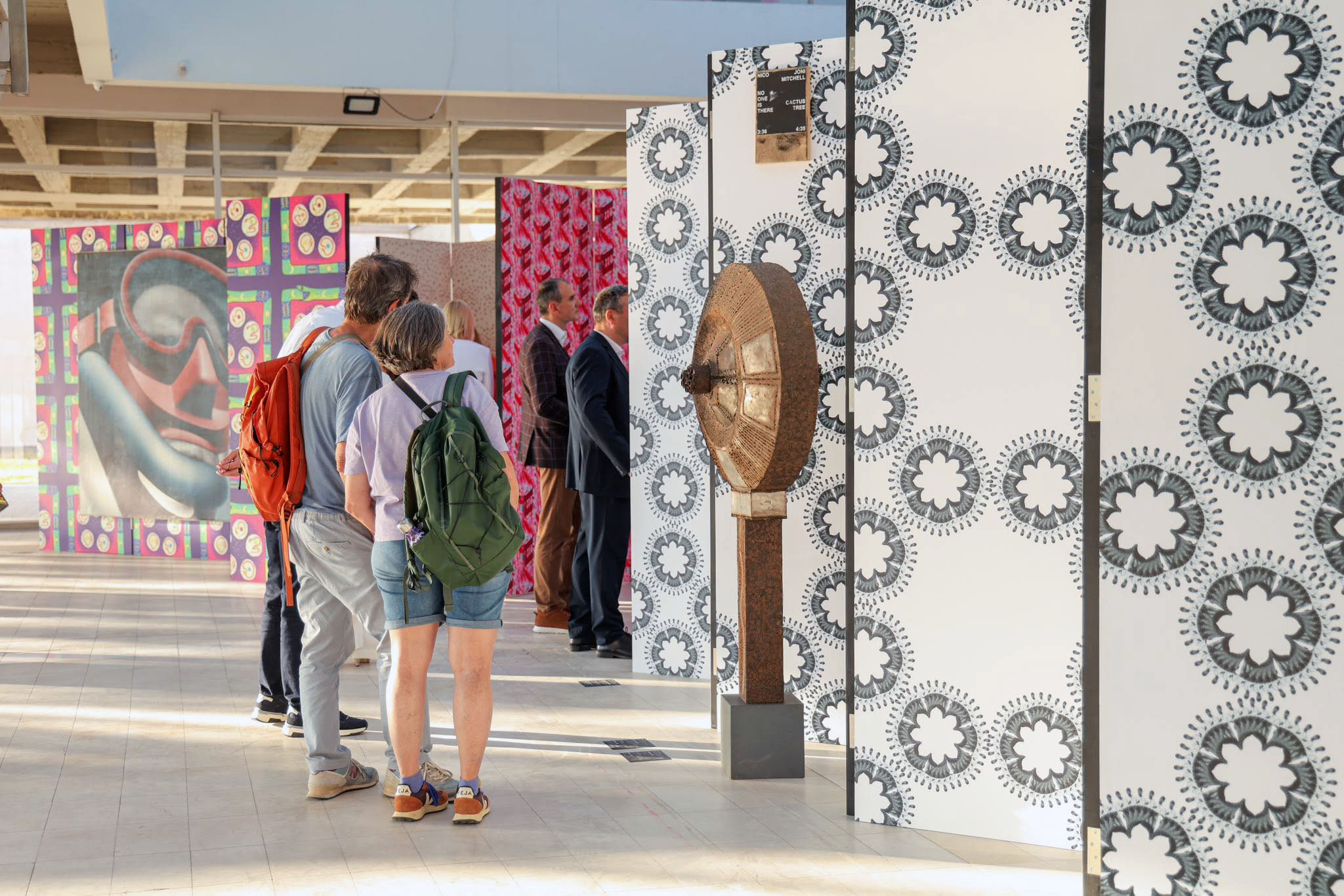
Marking the centenary of the artist’s birth in 2026, Lost in the Cracks: Aubrey Williams and Others in the MoCA-Skopje Collection begins with the rediscovery of two of Williams’ paintings, displayed for the first time since their separate donations in the 1960s, and for the first time in the Western Balkans. From this core, ripple out works from the Collection donated by artists, galleries, and communities to which Williams was related, following the seismic waves of an earthquake. Works by Denis Bowen, Kenneth Coutts-Smith, Frank Avray Wilson, Halima Nalecz, and others associated with the New Vision Centre Gallery in London, suggest how and why Williams’ works might have travelled to Skopje. The following waves propose more speculative connections with artists based in the former Yugoslavia and beyond, many of whom shared Williams’ artistic interest in ‘natural’ disasters. Lost in the Cracks thus offers new and relational perspectives of artistic responses to the 1963 earthquake which led to the creation of the Skopje Solidarity Collection, as part of large-scale, transnational efforts to rebuild the destroyed city.
Guest curator Jelena Sofronijević follows the notion of ‘trembling with’ museum collections from the Martinican thinker Édouard Glissant (1928-2011), as a practice to ‘refuse all categories of fixed and imperial thought.’ Works from contemporary artists Emii Alrai and Leo Robinson give form to this critical perspective, including a new audio piece in response to an opera scored by Dmitri Shostakovich, a composer, close friend, and inspiration of Williams. This site-specific work, developed in North Macedonia, is situated with reproductions of Williams’ works from British art collections in Yorkshire including Cartwright Hall in Bradford, a city twinned with Skopje following the 1963 earthquake.
Regarding the ‘end’ as a starting point, curator Vladimir Janchevski identifies an opportunity to further interrogate contemporary apocalyptic discourse through the perspectives of authors such as Bonaventura de Sousa Santos, Joanna Zylinska, and T. J. Demos. Works from the MoCA-Skopje collection—featuring numerous and diverse representations of ecological crises, as well as the destruction and absence of the human figure—offer a chance to re-examine various tropes concerning the ‘end of time’ and non-being. Suppressed epistemologies, which allow catastrophe to be viewed as something more than a mere existential threat, present an opportunity for new utopian perspectives. Francisco Tomsich’s installation—rooted in his long-standing connection to Skopje and looking back into the past—offers a contemporary take on how we understand the relationship between socio-political and natural catastrophes.
Lost in the Cracks reflects upon continuing relations between collections, communities, and cultural workers—and, from the cracks, seeks to lift solidarities that can be used in the construction of our shared futures.
Artists: Aubrey Williams, Ahmed Parvez, Alberto Burri, Aleksandar Jankulovski – Cane, A. Oscar (Peter Sheldon-Williams), Birgit Skiold, Boro Mitrikjeski, Brian Rice, Colin Saxton, David Hockney, Denis Bowen, Dimche Koco, Done Miljanovski, Dragan Poposki – Dada, Dragutin Avramovski – Gute, Dušan Džamonja, Dushan Perchinkov, Emii Alrai, Erna Rosenstein, Ferdinand Kulmer, Francisco Tomsich, Frank Avray Wilson, Halima Nalecz, Hans Hartung, Harry Ousey, Henry Moore, Howard Hodgkin, James Boswell, Jennifer Dickson, John Dickerson, Kenneth Coutts-Smith, Kenneth Rowat, Leo Robinson, Li Yuan-chia, Minne Fry, Mira Spirovska, Mohammed Ahmed Abdalla, Munira Al-Kazi, Mustafa Walid Siti, Neil Murison, Nikola Martinoski, Olga Jevrić, Ordan Petlevski, Petar Hadzi Boshkov, Petar Lubarda, Petar Mazev, Petre Nikoloski, Pip Beneviste, Radovan Kraguly, Risto Kalchevski, Risto Lozanovski, Roberto Matta, Rodoljub Anastasov, Scott Dobson, Sōfū Teshigahara, Stefan Manevski, Teresa Pągowska, Victor Anton, Victor Pasmore, Wha Ying Chow, Wilfredo Lam, Yoel Schwarcz, Zoran Mušič.
Curators: Jelena Sofronijević and Vladimir Janchevski
Collaborators: Iva Dimovski, Blagoja Varoshanec; Conservator: Ljupcho Iljovski; Graphic Design: Iliana Petrushevska; Layout: Albana Bektesh Ramadani; Technical team: Jordan Arsovski, Marjan Gjorgjiev; Coordination: Besnik Emini, Fanol Ademi
The exhibition consists of works from the MoCA Skopje collection, and works by invited contemporary artists.
Biographies:
Emii Alrai (b. 1993, Blackpool) is an artist whose work spans material investigation in relation to memory, critique of the western museological structure and the complexity of ruins. Working primarily in sculpture and installation, her work operates as large-scale realms built in relation to bodies of research which concern archaeology and the natural environments objects are excavated from. Her practice weaves in oral histories, inherited nostalgia and the details of language to question the rigidity of empire and the power of hierarchy to interpolate the static presence of history.
Leo Robinson (b. 1994, Newcastle-under-Lyme) is a London-based multidisciplinary artist. His work explores new models of ritual and ceremony through sculptural installation, video, sound, and diagrammatical works, speculating on how we might form new systems and symbols from an amalgamation of pop-cultural, mythological, and theoretical sources. Robinson has exhibited at Chapter Arts Centre, Cardiff; KU Leuven; The Hunterian, Glasgow; Sainsbury Centre, Norwich; and London Mithraeum Bloomberg Space. In 2025, he was awarded the Art Foundation Futures Award for Visual Art. His music has been released with PRAH Recordings and performed live on BBC 6Music.
Francisco Tomsich (b. 1981, Uruguay) is a Slovene/Uruguayan artist and author currently based in Istria. His practice is rooted in the urgency to create critical dialogues between images of the past, notions of present and active models of future. He produces exhibitions, publications, works for the stage, research models and pedagogical devices, operating with different media, languages and tongues. He has co-founded and integrated many non-disciplinary associations of cultural workers in South America and Europe. He was awarded the National Prize for Literature of the Ministry of Education and Culture of Uruguay (2012 and 2025) and the FEFCA Scholarship for young artists from the same institution (2013). He participated in the 7th MERCOSUR Biennial (2009) and the 1st Montevideo Biennial (2012).
Jelena Sofronijević ( @empirelinespodcast ) (b. 1998, Telford) is a producer, curator, writer, and researcher, working at the intersections of cultural history, politics, and the arts. Their independent curatorial projects include Invasion Ecology (2024), Seeds of Hate and Hope, at the Sainsbury Centre (2025), and Peripheries and Horizons, with the House of European History (2026). Jelena produces EMPIRE LINES, a podcast which uncovers the unexpected flows of empires through art, supported through their role as Curator with Radical Ecology (2026-2027). They are also pursuing a practice-based PhD with Gray’s School of Art, curating exhibitions with Balkan and Yugoslavian/diasporic artists in British art collections. Much of Jelena’s research centres on pluralising representations of Central, Eastern and Southeastern Europe (CESEE)/diaspora communities and cultures, particularly from the Balkans and Yugoslavia, and more constructive, contemporary histories of non-alignment. More widely, they seek to platform lived experiences and perspectives often marginalised or excluded from representation, especially in anti-colonial and environmental activism. Jelena’s review of the monograph Aubrey Williams: Art, Histories, Futures (2024), edited by Ian Dudley and Maridowa Williams, and published by the Paul Mellon Centre for Studies in British Art in association with Yale University Press, was published by The Art Newspaper in 2025.
Vladimir Janchevski (b. 1984, Skopje) curator at the Museum of Contemporary Art in Skopje, working simultaneously in the field of contemporary art and visual studies. He is interested in interdisciplinary art practices and image theory, interventions in public space, iconoclastic acts and ‘image wars’. Since 2004 he co-organized, curated and participated in numerous events: group exhibitions, collaborative projects, lectures and public discussions. He was a core member of the art initiative KOOPERACIJA (2012-2015). Collaborates with the Center for Visual Studies-Skopje since its foundation in 2011, participated in several international conferences. He curated group shows and solo exhibitions of artists among which are Igor Grubic, Nikola Uzunovski, OPA Group, Alban Muja, Iskra Dimitrova, Jianan Qu, Artur Żmijewski, Driton Selmani). He is the recipient of the 2019 “Ladislav Barishic” Award for art criticism by the national section of AICA-Macedonia.
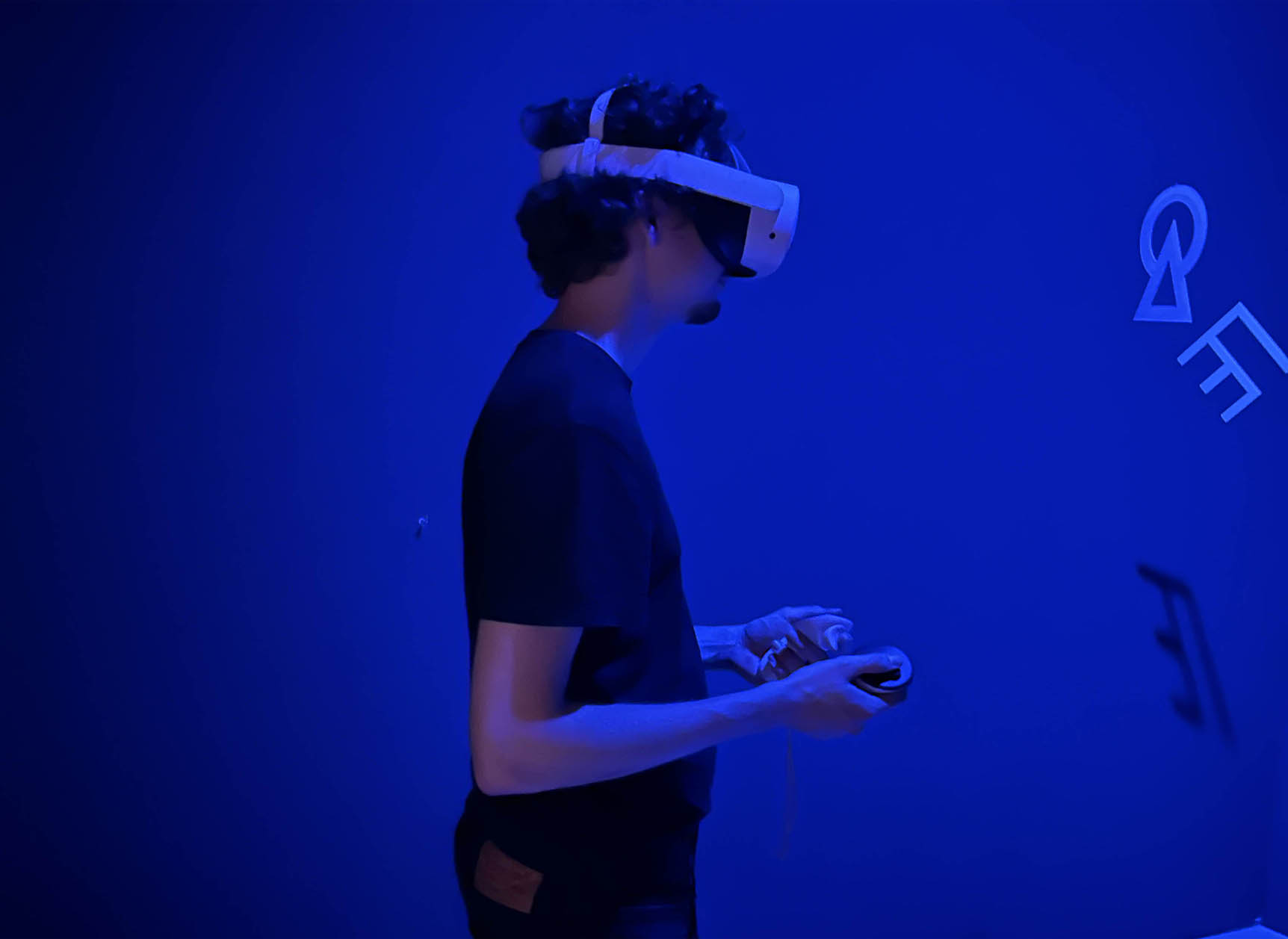
LAZE TRIPKOV: Immersive Transformation of the Glagolitic
21/08/2026 – 05/09/2026
INTERRUPTION IN PROGRESS
29/07/2026 - 20/08/2026

BUILT ENVIRONMENT: An Alternative Guide to Japan
16/07/2026 - 17/09/2026
WALLPAPERS
02/06/2026 - 30/07/2026

